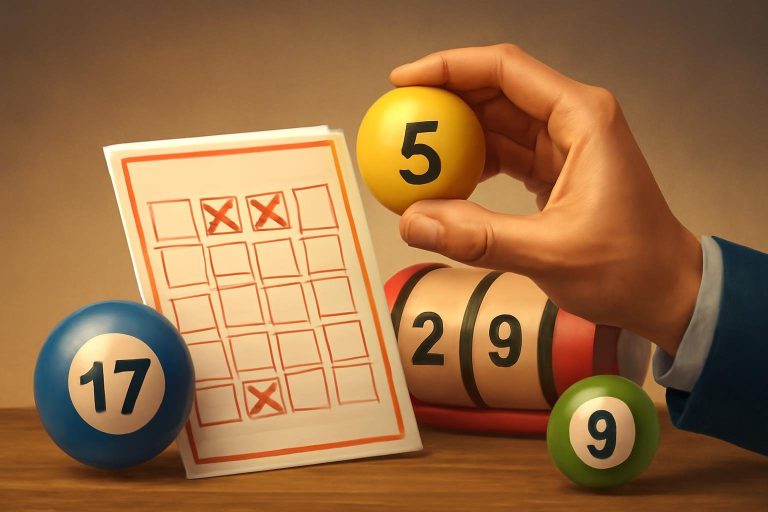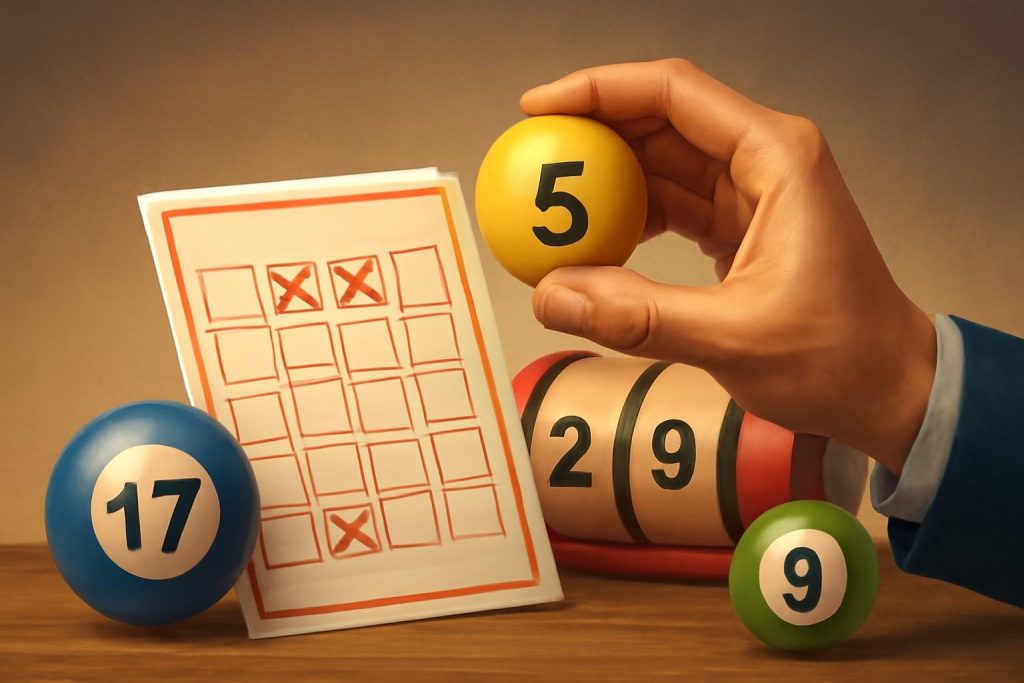
The Numéro Chance has a precise mathematical role in France's Loto. It is a separate selected value, not a vague description of luck and not another main number from the same field. A complete top-match calculation therefore combines the five-number main set with that additional condition.
When interpreting loto (france) odds, begin with one standard selection in one draw. The main field contains five different values from 49, and the Numéro Chance comes from ten values. That definition lets a reader separate a main-only match, a Chance-number match and the full top condition before considering prize labels.
The main field contains five-number sets
There are 1,906,884 possible five-number subsets of a 49-number field. Order does not matter to the main selection, so writing the same five values in a different arrangement does not create another possible line. A fixed valid main set has a one-in-1,906,884 chance of matching all five main values in a fair draw.
This main-only event leaves the Chance outcome unrestricted. It can be useful to discuss, but its denominator should not be presented as the complete top-match chance. The remaining field is a real condition that must be included when the event requires it.
Ten Chance possibilities complete the space
Each main set can be paired with ten possible Numéro Chance values. Multiplying the field counts gives 19,068,840 complete selections. One particular valid complete selection therefore has a one-in-19,068,840 chance of matching the five main values and the Chance number under the fair-draw model.
A numeric label can appear in both fields because their roles differ. A calculation that removes those cross-field coincidences would describe an artificial restricted game. Uniqueness belongs within the main set, while the separate Chance value retains its own permitted range.
A Chance match regardless of main result is broader
For one specified permitted Chance value, the chance of matching that field is one in ten in a fair draw. This marginal statement ignores the main result. It includes every possible main-match count, from none through all five.
An exact prize category can add a condition on the main overlap. Its probability is therefore not automatically the same as the broad one-in-ten Chance statement. The current prize table determines the relevant award definitions, and the probability explanation needs to preserve the full conditions rather than relying on a shortened label.
Main overlap requires matched and unmatched values
To count exactly a specified number of main matches, choose those values from the winning main set and the remaining selected values from outside it. Both choices are necessary to describe a complete five-number main selection. Counting only the winners leaves part of the event unspecified.
Then apply the Chance condition where the category requires it. An at-least-main-match statement can combine several exact categories, while a complete category can distinguish matching and non-matching Chance outcomes. The calculation should state which interpretation it uses before a reader compares it with another table.
Additional draw opportunities remain separate
If a particular accepted entry includes an associated draw or option, identify its rules and participation separately. Reusing selected values does not turn two draw opportunities into a single larger main selection. A combined probability requires a clear event definition and the appropriate assumptions about the relationship between draws.
The same care applies to repeated participation over time. A single-draw denominator does not guarantee a success after that many attempts. Under unchanged rules and fair independent draws, previous failures do not alter the next opportunity's complete-selection space.
Award amounts and probabilities answer different questions
A changing advertised award can alter what a qualifying entry might receive without changing the five-from-49 and one-from-ten matrix. An any-prize figure also does not automatically describe the chance of a net gain after costs. It describes the union of the qualifying award events included in its definition.
A useful event map begins with every possible main overlap beside each possible Chance outcome. The broad Chance-match statement collects the matching special-field outcome across all main overlaps. An exact category selects only the appropriate part of that collection. This view explains why the one-in-ten fraction can be correct as a marginal statement and incomplete as an exact-category statement at the same time. The current prize table then supplies award labels for the relevant parts; it does not change the underlying distinction between the broad event and its narrower subsets.
The useful interpretation of France Loto probabilities is to retain the two fields and exact event label beside each number. That makes main-only, Chance-only and complete-match statements distinguishable. It also explains why a convenient small fraction for the special field should not be mistaken for the likelihood of every precisely defined prize category.